Not so long-long ago in a galaxy not so far-far away, former Idaho Governor Dirk Kempthorne ran the United States Department of Interior, serving almost the entirety of President George W. Bush’s second term.
It was in the home stretch of his Secretarial stint that Kempthorne unveiled a broad and ambitious plan that involved five federal agencies, creating an initiative that would withstand the scrutiny and political trade winds of every presidential administration since.
In October of 2008, Secretary Kempthorne launched the Bison Conservation Initiative (BCI), acknowledging the iconic status of the animal and stating, “Americans today still find inspiration in bison ranging freely on the landscape…our initiative acknowledges the important role of bison on the landscape, in tribal culture and in our national heritage.”
Primarily focused on maintaining genetic diversity of Interior-managed herds and establishing partnerships in bison conservation efforts, the first iteration of the Bison Conservation Initiative called for a Working Group that would allow “small bison herds to recreate their natural role in areas where they are not now found.” At the time, there were roughly 7,000 bison using seven national wildlife refuges and five national parks. The plan also suggested that “such arrangements … could also become important tourist attractions and may help support the restoration or maintenance of other native species and habitats.”
So began our country’s process to restore what is perhaps its greatest keystone species, not just for conservation purposes, but to recognize and honor its cultural, material, familial and spiritual significance to many Native American Tribes.
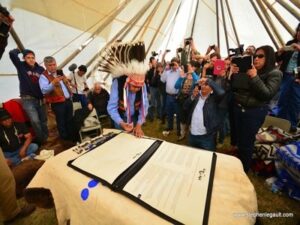
In the past five years, ideas that gave rise to the 2008 Bison Conservation Initiative have been amplified and sharpened. In 2020, a renewed “BCI 2.0” reaffirmed Interior’s commitment to the restoration of wild bison and incorporated “ecocultural” principles to the process—embracing place-based connections between ecology and humans—especially Indigenous culture. It recognized the intentionally ruinous effects that federal policies in the 1800s had on Indigenous peoples and their relationships to bison. It established that both ecological and cultural dimensions of the animal must be co-equal pillars of “shared stewardship” restoration efforts. It also took inspiration from the Indigenous-led Buffalo Treaty, originally signed in 2014 by 13 Native nations on eight reservations across Canada and the western United States, as “a living agreement between Indigenous Nations to restore the buffalo to the land, the people, and our way of life.”
Then, two years ago, came Interior Secretary Deb Haaland’s Order 3410 – Restoration of American Bison and the Prairie Grasslands. For the first time, Interior’s bison conservation efforts recognized that “…in addition to depriving Tribes of a critical resource and lifeway, the persecution of bison contributed to the decline of healthy grassland ecosystems.” In spotlighting this connection, Secretary Haaland stated the Department would “embrace(d) ecocultural restoration as an essential component of the federal trust responsibility to Tribes and Tribal members.” She emphasized that “…restoring bison and healthy grasslands can serve as a step toward national healing and reconciliation after centuries of federal policies designed to erase Native people and their cultures.”
Since the era of Manifest Destiny and the plunder of native species by market hunters, there have been many successful efforts to restore large mammals on American landscapes—primarily in the West. However, none have centered conservation efforts on 500 generations of human/mammal relationships or tried to meaningfully address Indigenous trauma as part of species restoration.
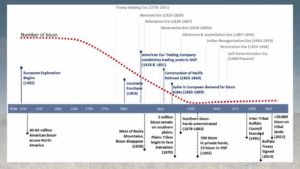
Brick by brick, over the course of the past 15 or so years, officials at the Department of Interior have now begun aligning bison conservation by understanding a basic premise: the nature of the bison is such that you can’t try to restore them without placing human relationships at the center of those efforts.
The capstone of this ongoing American bison restoration project arrived last year, with the Bison Working Group’s release of the Bison Shared Stewardship Strategy.
At its core, the new framework emphasizes that, for many Tribes, federal trust responsibilities obligate the U.S. Government to restore “bison, other native wildlife and ecosystems on federal, Tribal, and private lands, to restore Tribal food sovereignty, nutritional health, and cultural and spiritual connections to bison.” It also acknowledges that, through federal intervention, American bison have been saved from extinction, but that subsequent restoration efforts have been “insufficient to restore the ecological function of bison to imperiled temperate grasslands.” It establishes partnership-based, eco-cultural bison restoration efforts, by bridging Indigenous and Western paradigms. It sets forth shared stewardship principles to reintegrate buffalo into Tribal lifeways, depleted grassland ecosystems, and an impoverished American awareness of our national mammal. It even expresses the voice of the buffalo (her/himself) as a co-author of the document (the Bison’s emotional passage from the Strategy can be found on P. 5).
Importantly, this new restoration template also “recognizes wild bison as native North American wildlife” and commits to the Department of Interior to “establish and maintain large, wide-ranging bison herds on appropriate large landscapes where their role as ecosystem engineers shape healthy and diverse ecological communities.” According to the framework, a primary tool to accomplish this work is to prioritize Tribal-led opportunities to establish and grow those herds.
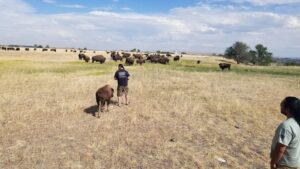
Many projects to return bison to Tribally-owned and ancestral lands have already emerged since Secretary Kempthorne’s original version of the Bison Conservation Initiative. One of the earliest came in 2012, when 60 bison from Yellowstone National Park were released at the Fort Peck Indian Reservation in eastern Montana, after five years in a quarantine facility to prevent potential transfer of brucellosis to domestic cattle. Last year, ICL wrote about our visit to the Wind River Tribal Buffalo Initiative, north of Lander, WY, where the Northern Arapaho and Eastern Shoshone Tribes originally received 20 bison in 2016. As co-managers on a shared reservation, they’ve grown the herd to over 200 and recently passed a Tribal resolution declaring Territorial buffalo to be native wildlife, rather than livestock, affording them more protective management status.
More recently, a diverse and growing array of western Tribal bison initiatives has built upon earlier efforts, accelerated by the announcement of S.O. 3410 and the Bison Shared Stewardship Strategy:
- Confederated Salish and Kootenai Tribes (2022): The U.S. Fish & Wildlife Service assigned full management responsibilities of over 300 bison to the Confederated Salish and Kootenai Tribes (CSKT) on the 18,000-acre National Bison Range. Located on the Flathead Indian Reservation, 50 miles north of Missoula, MT, the re-named Bison Range hosts some of the country’s last best intermountain bunchgrass prairie habitat.
- Blackfeet Reservation Iinnii Initiative (2023): Decades of Tribal activism led to a “focus on rebuilding the communities’ connection to Iinnii (buffalo, in the Blackfoot language) through dialogues, youth involvement, and celebration” to re-establish free-roaming bison to reservation lands in Montana for the first time in 150 years. Bring Them Home, a PBS production, recently debuted as a full-length documentary about the Iinnii Initiative.
- Colville Confederated Tribes (2023): Released 30 bison gifted from the Kalispell Tribe to range freely over 26 square miles of Tribal lands in north-central Washington.
Here in Idaho, this past spring, the Nez Perce Tribal Executive Committee pointed to the decimation of buffalo populations and the need for the Tribe to “continue our culture and way of life by providing the foods native to the area”, when they adopted a historic resolution to “…work on researching and acquiring buffalo to be brought to the Tribe for management and development of a Buffalo herd.” ICL recently attended the second of two events hosted by Nimiipuu Protecting the Environment, a Nez Perce Tribal member run non-profit, convened to help develop a consensus around a Nez Perce bison initiative.
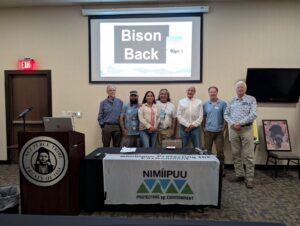
It was there that Keith Aune, current chair of the IUCN Bison Specialist Group who worked with the Blackfeet Confederacy to restore bison to the Glacier-Waterton Front, drew on his experiences to summarize the necessary ingredients for successful Tribally-led bison restoration efforts:
- Create a unifying vision and share it
- Connect healthy lands to healthy communities and healthy species (bison + mankind)
- Practice shared stewardship and build a strong community of interest
- Conserve at the right scale, in time and space
These ideas will continue to serve the relationship-building exercise that is ecocultural bison conservation. As we celebrate successes, and plans gain steam for more bison on more Tribal landscapes, we’re beginning to realize this is much more than a wildlife effort. It is a profound undertaking of healing and reciprocity.
As Melissa Little Plume Weatherwax, an Amskapi Piikani (Blackfeet) Educator and Knowledge Holder said during a series of interviews on the Iinnii initiative, bison restoration “takes us out of the history books. It takes us out of assimilation. It takes us out of genocide because once we get our food back the way it was intended, then we’re reversing genocide, then we’re gonna be there for what they call [in perpetuity]. And finally, that’s a reality.”